
The Reticular Activating System (RAS): The Scientific Explanation for Why Manifestation Works
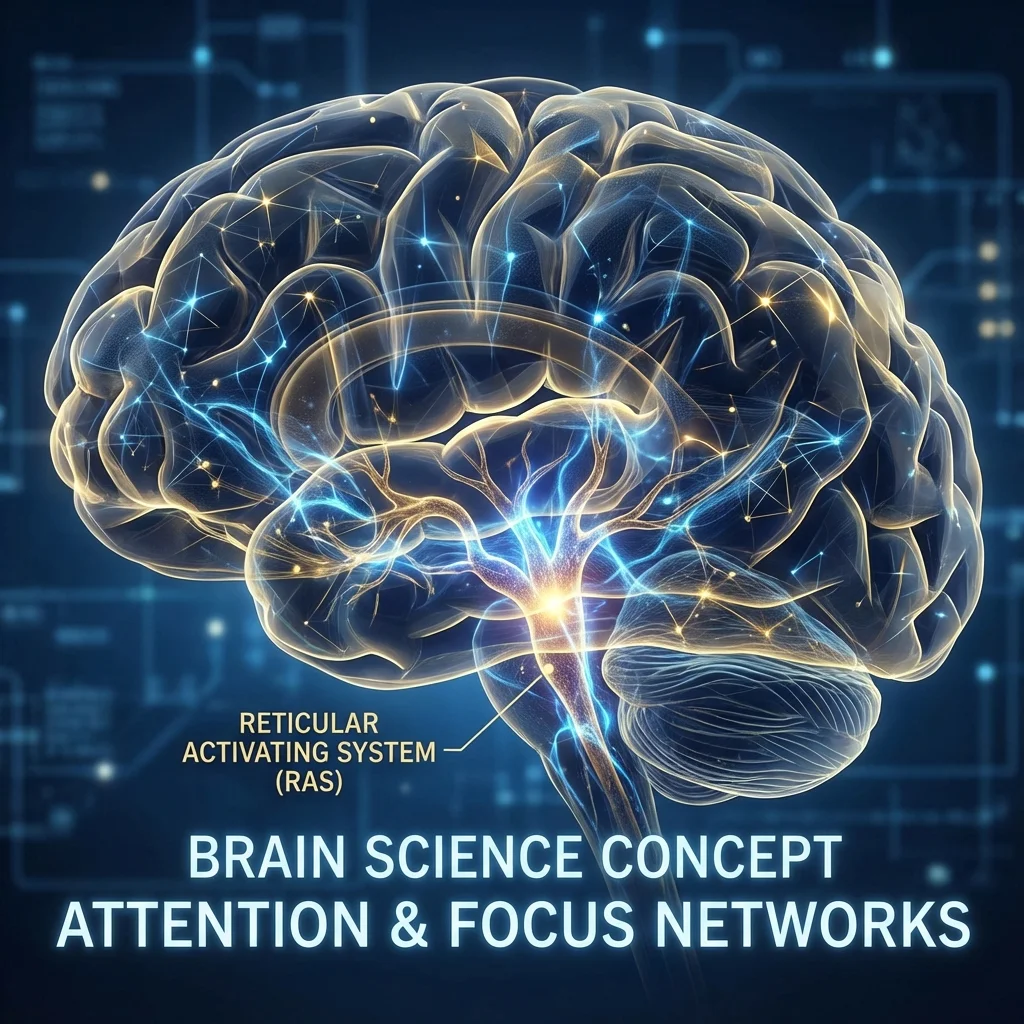
Every time someone says manifestation is "woo-woo," they haven't heard about the Reticular Activating System. The RAS is a neurological mechanism that explains, in scientific terms, why your thoughts influence what shows up in your life. Let's bridge the gap between spiritual practice and brain science.
What Is the Reticular Activating System?
The Reticular Activating System (RAS) is a network of neurons located in the brainstem. It functions as a filter between your subconscious and conscious mind, determining which of the millions of pieces of sensory data around you gets noticed.
Your brain processes approximately 11 million bits of information per second. Your conscious awareness can handle about 40. The RAS decides which 40 you perceive.
Think about it: you're in a crowded room with dozens of conversations happening. You tune most of them out—until someone mentions your name. Suddenly, you hear it clearly across the noise. That's the RAS at work.
Or: you decide to buy a specific car model, and suddenly you see that car everywhere. They were always there—your RAS just started flagging them as relevant.
The RAS as Manifestation Mechanism
Here's where it gets interesting for manifestation practitioners:
The RAS prioritizes what you've told it matters.
When you repeatedly visualize a goal, affirm an intention, or emotionally focus on a desire, you're programming your RAS to treat related information as significant. Your brain then:
- Notices opportunities you would have ignored
- Connects dots you wouldn't have seen
- Remembers relevant information more readily
- Filters for confirmation of your focus
This isn't magic—it's literally how your neurology works. The "universe" bringing you opportunities may actually be your brain finally noticing what was already there.
Simple example:
You visualize starting a business. The next week, you overhear a conversation about funding opportunities. That conversation was happening anyway—but before your RAS was programmed, you wouldn't have heard it over the noise.
Did manifestation attract the conversation? Or did it train your brain to perceive it?
The outcome is the same. The mechanism is neurological.
How to Program Your RAS for Manifestation
1. Clarity Is Everything
The RAS can't filter for vague. "I want more money" gives it nothing specific to flag.
"I'm looking for opportunities to earn $10,000 through my skills in the next 90 days" gives it search parameters.
Be specific with desires. The more concrete, the easier for your RAS to scan for matches.
2. Repetition Compounds
The more often you expose your RAS to an idea, the more priority it assigns.
This explains why:
- Robotic affirmations work through sheer repetition
- Daily visualization is more effective than occasional
- Mental diet matters—sustained focus reprograms filtering
You're not "convincing the universe." You're conditioning the brain to recognize different data.
3. Emotion Intensifies Flagging
The RAS gives priority to emotionally charged information. This is survival wiring—threats and rewards get attention.
Emotionally charged visualization (feeling joy, excitement, gratitude for the desired outcome) tells the RAS: this is important, flag it with high priority.
Flat, emotionless technique doesn't engage the RAS as strongly.
4. Questions Direct Filtering
Ask yourself a question, and your RAS starts scanning for answers—even when you're not consciously thinking about it.
"How could I increase my income by $5,000?" sets a filter. Answers may appear hours or days later from unexpected sources.
Good manifestation includes good questions.
5. Existing Beliefs Are Already Filters
Your subconscious beliefs have already programmed your RAS—often in limiting ways.
If you believe "money is hard to make," your RAS may actually filter OUT easy money opportunities. They don't match the programming.
This is why self-concept work and belief clearing matter. You're not just adding new intentions—you're overwriting old filters.
RAS Explains Several Manifestation Phenomena
"Signs" and Synchronicities
After setting an intention, you start seeing related messages, numbers, or themes everywhere. Are these cosmic signals?
Maybe. But they're definitely perceptual shifts. Your RAS is now flagging things it ignored before. The 11:11 was always there—you just started noticing it.
This doesn't make synchronicity meaningless. It changes the mechanism: rather than the universe sending signs, you're becoming attuned to relevant patterns.
Neville Goddard described how manifestations arrive through natural sequences of events rather than magic. Person A leads to person B leads to opportunity C leads to your desire.
The RAS explains this: once programmed, your brain connects dots across multiple encounters. You follow the thread because you're perceiving the thread. Others miss the same connections because their filters differ.
After visualization, nothing seems to change for days or weeks. Then suddenly, things shift.
The RAS needs time to condition. And opportunities need to enter your field before they can be perceived. The lag isn't metaphysical delay—it's filtering system update plus opportunity intersection.
Why Manifestation "Doesn't Work" for Skeptics
A skeptic sets an intention they don't believe in, waits for magic, sees nothing, and confirms, "it doesn't work."
RAS perspective: they didn't genuinely program the filter. Saying words without emotional engagement doesn't condition the RAS. Their dominant programming remains "this is fake," which filters for confirming evidence.
Belief is the programming. No belief = no new programming = no new perception.
The RAS Isn't Everything
Important caveats:
RAS explains opportunity perception, not opportunity creation. If you're visualizing a job but there are no job openings in your field, no amount of RAS programming finds what doesn't exist.
However: your RAS might find related opportunities, alternative paths, or connections you wouldn't have made from the limited conscious view.
External factors still matter. Skills, preparation, timing, connections—these create the opportunities your RAS can flag. Visualization alone doesn't replace competence.
Some manifestation claims remain unexplained. The RAS model explains noticing and connecting. It doesn't explain stories of money appearing unexpectedly, physical healing, or reality seeming to shift in unusual ways. Those require additional frameworks—or remain mysteries.
The RAS is a partial explanation. A compelling one. But probably not the complete picture.
What RAS science confirms:
- Your brain is already filtering reality
- You can intentionally reprogram those filters
- Visualization and repetition genuinely change perception
- Changing perception changes what opportunities you encounter
- This is neurology, not magic (though the results may feel magical)
Practical Application
The RAS-Focused Manifestation Protocol
-
Get clear on one specific goal — Write it in concrete, measurable terms.
-
Create visualization material — Images, vision boards, detailed descriptions. Give the RAS specific search patterns.
-
Daily exposure — Morning and evening, spend 2-5 minutes viewing your material with emotional engagement.
-
Ask directing questions — "What's one thing I could do today toward this?" Let your RAS scan during the day.
-
Stay alert for connections — Your RAS will flag things. Notice them. Follow up. Even if they seem tangential.
-
Review and refine — Weekly, check if anything has shown up. Adjust visualization for clarity.
This is essentially standard manifestation practice—understood through neuroscience.
For Teachers and Coaches
If you're teaching manifestation to skeptical audiences:
Lead with RAS. It's credible, scientific, and introduces core concepts (focus, repetition, emotional charge) without requiring belief in metaphysics.
Let people experience it. Ask them to choose an unusual car and see how often they spot it in the next week. Their own experience of RAS shift opens the door.
Build from science to expansion. Once RAS is understood, you can introduce ideas beyond strict neuroscience—and students have a rational foundation to build on.
Final Thoughts
The Reticular Activating System won't explain all manifestation phenomena. But it grounds core practices in brain science:
- Focus works because attention modifies filtering
- Repetition works because frequency builds priority
- Emotion works because survival systems flag emotionally charged data
- Belief works because existing programs must change before new filters emerge
For skeptics, RAS is the entry point. For experienced practitioners, RAS is the mechanism. For teachers, RAS is the bridge between spiritual practice and scientific credibility.
Your brain is already manifesting—you're perceiving a filtered reality based on previous programming. The question is whether you take control of the filter or leave it to default conditioning.
Manifestation isn't about creating reality from nothing. It's about training yourself to see the reality that serves you.
The RAS is how you do it.
Activate Your Wealth DNA
Struggling to manifest abundance? Your Root Chakra might be blocking your financial flow. Discover the 7-minute audio that activates your wealth potential.