
The Double-Slit Experiment and Consciousness: Does Observation Really Create Reality?
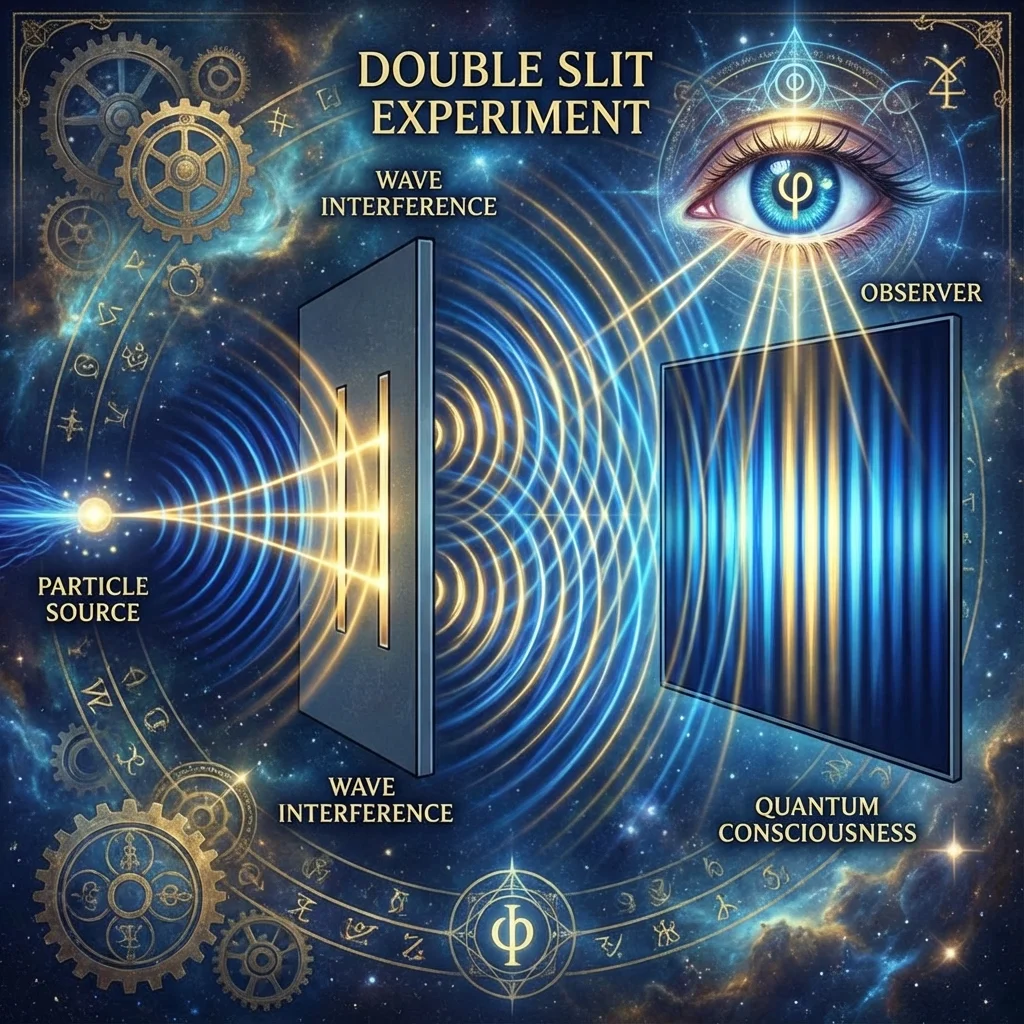
"Quantum physics proves thoughts create reality!" You've heard this claim. It sounds scientific. It validates manifestation. But is it accurate? The double-slit experiment—often cited as proof—is genuinely strange. Let's explore what it actually demonstrates, where the consciousness interpretation comes from, and what it means for manifestation practitioners who want to be intellectually honest.
The Experiment Explained
The double-slit experiment is one of the most famous demonstrations in physics. Here's what happens:
Setup
A barrier with two parallel slits is placed between a particle source (electrons, photons, or other quantum particles) and a detection screen.
Without Observation
When particles are fired through the slits without measuring which slit each passes through, the detection screen shows an interference pattern—alternating bands of high and low intensity. This is the signature of wave behavior. The particles somehow pass through both slits simultaneously (as waves do), interfering with themselves.
With Observation
When detectors are placed at the slits to measure which one each particle passes through, the interference pattern disappears. Instead, two bands appear directly behind the slits—as if particles behave like bullets passing through one slit or the other. Wave behavior vanishes.
The Strangeness
The act of measuring which slit the particle passes through changes how it behaves. Somehow, observation seems to affect physical reality.
The core mystery: Quantum particles behave like waves when not observed, but like particles when observed. Measurement appears to "collapse" the wave function into definite particle behavior.
The Consciousness Interpretation
Here's where it gets controversial—and where manifestation teachers often jump.
The Observer Effect Argument
Some interpretations (most famously associated with physicist John Wheeler and the "participatory universe" idea) suggest that consciousness itself causes wave function collapse. If this were true, it would imply:
- Mind directly influences matter
- Reality doesn't exist in definite form until observed
- Consciousness is fundamental to physical reality
This maps beautifully onto manifestation concepts: your observation (awareness, focus, intention) creates or selects your reality.
What Mainstream Physics Says
Most physicists interpret "observation" more narrowly:
Interaction, not consciousness. What collapses the wave function is interaction with a measuring device—physical interference, not awareness. A detector without a human watching still causes the effect.
Decoherence. Modern quantum theory explains collapse through environments that "decohere" quantum superpositions. Conscious observation isn't required—any sufficiently complex system interaction does it.
No evidence consciousness is special. Experiments haven't demonstrated that human consciousness behaves differently from unconscious physical detectors.
The majority scientific view: the double-slit experiment demonstrates quantum weirdness, but not necessarily conscious creation of reality.
The Deep Divide
Copenhagen Interpretation
The original and most common interpretation. The wave function is a mathematical tool; measurement yields definite results; don't ask what happens "before" measurement—it's meaningless.
Many-Worlds Interpretation
No collapse happens. Every quantum possibility actualizes in branching parallel universes. You experience one branch. Consciousness isn't creating reality—you're just riding one track of infinite simultaneously-real tracks.
Consciousness-Causes-Collapse (Von Neumann, Wigner)
A minority view: consciousness is where the chain of physical interactions terminates and collapse actually occurs. This is the interpretation manifestation teachers love, but it's not mainstream.
Pilot Wave Theory (Bohm)
Particles are always particles, guided by a wave. No collapse, no observer effect mystery. Deterministic.
The point: There is no scientific consensus that consciousness creates reality. There are interpretations that allow for it, but they're not proven.
Intellectual Honesty for Manifestation Teachers
If you teach manifestation, here's how to handle quantum claims responsibly:
What You Can Say
- "The double-slit experiment shows that observation affects quantum systems in ways we don't fully understand."
- "Some physicists propose consciousness may play a role in quantum mechanics."
- "There are interpretations of quantum physics compatible with mind-matter interaction."
- "Science hasn't proven consciousness creates reality, but it hasn't disproven it either."
What You Shouldn't Say
- "Quantum physics proves thoughts create reality."
- "Scientists agree that consciousness collapses the wave function."
- "The double-slit experiment shows you can manifest anything by observing it."
These overstatements invite legitimate criticism and undermine credibility.
Balanced position: Quantum physics is deeply strange. The observer's role is genuinely mysterious. Some interpretations align with consciousness-first models. But the science isn't settled, and claims should reflect that uncertainty.
What the Experiment DOES Support
Even without accepting consciousness-causes-collapse, the double-slit experiment challenges assumptions:
Reality Is Not Fixed Before Measurement
In some sense, quantum particles don't have definite properties until measured. This aligns with manifestation principles that reality is malleable, not solid.
The Observer Matters
Whether through physical interaction or otherwise, measurement changes outcomes. This supports the idea that how we engage with reality affects what we experience.
Classical Intuition Fails
Newtonian "billiard ball" physics doesn't describe fundamental reality. There's room for models we don't yet understand, including ones where consciousness is more fundamental than assumed.
Possibility Exists Before Actuality
The wave function represents possibilities. Definite outcomes emerge from fields of potential. This metaphorically (at least) mirrors manifestation frameworks where reality emerges from infinite potential.
Parallel Concepts in Manifestation
The double-slit experiment resonates with several manifestation ideas:
The Space of Variations (Reality Transurfing)
Vadim Zeland's concept of infinite possible realities, with consciousness selecting which one actualizes, echoes the quantum superposition concept.
Schrödinger's Cat and Assumption
The idea that all possibilities exist simultaneously until observation collapses them parallels Neville Goddard's teaching that assuming the wish fulfilled selects that reality from infinite possibilities.
Even without metaphysics, the RAS model shows how attention (a form of observation) literally determines what aspects of reality you perceive and engage with.
The Deeper Question
Perhaps the most profound implication of quantum physics for manifestation isn't about proof—it's about possibility.
Pre-quantum physics described a clockwork universe where consciousness was an accidental byproduct, reality was fixed, and free will was illusion. That model left no room for manifestation.
Quantum physics cracked that worldview open. Even if we don't fully understand how, the paradigm shifted from "matter is all that matters" to "something strange is happening with observation and reality."
That gap—that uncertainty—is where manifestation worldviews can live without contradicting established science.
For the Skeptical Student
If you're studying manifestation but scientifically minded:
-
Don't reject manifestation because quantum "proof" is oversimplified. The practice works regardless of theoretical justification. Mechanisms can be debated while results remain.
-
Don't accept manifestation because of quantum claims. Base your practice on personal experimentation and result, not physics you're taking on faith.
-
Stay curious about consciousness. The hard problem of consciousness—why subjective experience exists at all—remains unsolved. Premature certainty in either direction (consciousness creates all / consciousness is irrelevant) is unwarranted.
Final Thoughts
The double-slit experiment is genuinely strange. Observation does matter at the quantum level in ways we don't fully understand. Some interpretations allow for consciousness as fundamental to reality.
But scientific consensus has not confirmed that thoughts create physical reality. The leap from "observation affects quantum particles" to "your thoughts manifest your car" involves layers of extrapolation.
That doesn't invalidate manifestation. It means manifestation stands on its own—through personal experience, psychological mechanisms like the RAS, epigenetic effects, and perhaps mechanisms we haven't discovered.
Use the double-slit experiment as an invitation to wonder, not as proof. Wonder is enough.
Activate Your Wealth DNA
Struggling to manifest abundance? Your Root Chakra might be blocking your financial flow. Discover the 7-minute audio that activates your wealth potential.